学生数据如何脱敏?
教育AI助手选型:K12课堂最适合的三大模型比较
Student data should be de-identified before it enters an AI teaching assistant, especially during testing. The goal is not merely to remove a student’s name. A worksheet can still reveal identity through a phone number, contact information, grade, class details, handwriting, school uniform, face, home environment, or a combination of small clues.
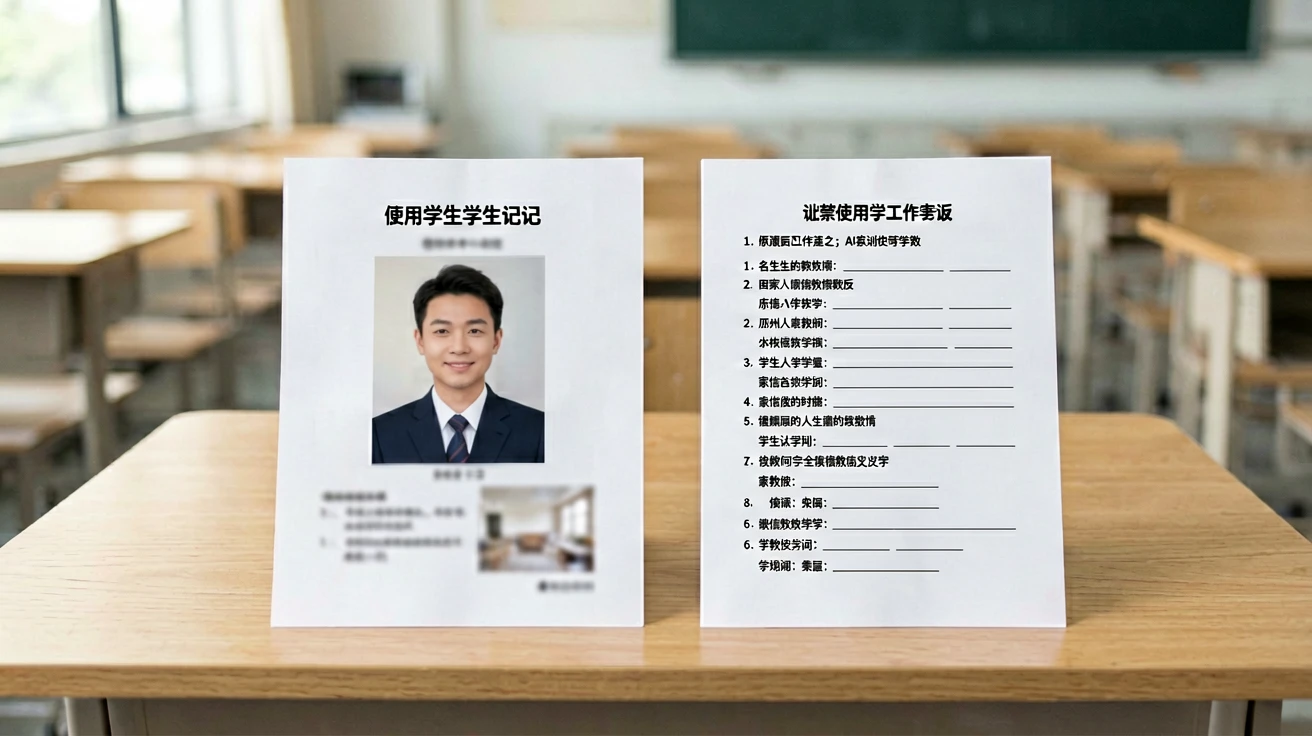
A practical approach begins with separating the original record from the material used for testing or analysis. Keep the source data in the school’s controlled system, and create a working copy that contains only the information necessary for the task. If the goal is to evaluate whether a model can explain a common math error, it may need the question and the incorrect reasoning—but not the student’s name, exact grade record, or family information.
What to remove, replace, and generalize
Some information should be removed entirely when it is not needed. This commonly includes names, contact details, student numbers, account identifiers, and family information. Other fields can be replaced with neutral labels, such as “Student A” or “Class Group 1.” This preserves the structure of the material without exposing the original identity.
Generalization is useful when exact details could make a student recognizable. A precise date might become a broader time period. An exact score might become a performance category, if the category is sufficient for the task. A specific class description might be rewritten in more general terms. The principle is simple: retain educational meaning, but reduce unnecessary identifying detail.
The same thinking applies to images. A photo of an assignment may include a student’s name, face, school badge, uniform, handwriting, or part of a bedroom. Cropping or obscuring these elements may be appropriate, but only if the remaining image still serves its purpose. If the task is to test chart interpretation, there may be no reason to include the student’s handwriting or the surrounding classroom.
Pseudonyms are helpful, but they are not the same as full anonymity. If a school keeps a separate key that links “Student A” to a real student, the data remains potentially identifiable within that environment. The key should be stored separately, access should be limited, and it should not be included in prompts, exported files, or shared samples.
Test the process, not just the sample
A de-identified sample can still be risky when several harmless-looking fields are combined. For example, a rare activity, a distinctive assignment, a particular class, and an unusual comment may point to one student even without a name. Review the complete record before sharing it, rather than checking only the obvious identity fields.
Schools should also define what happens after the data is submitted. Before using any service, confirm where inputs are stored, who can access them, how long they are retained, whether they may be used for other purposes, and whether the school can delete them. Images and student work should be considered part of the privacy review, not treated as ordinary attachments.
A small pilot using fictional names, de-identified assignments, and materials without identity information is safer than beginning with real student records. Teachers can then evaluate whether the model understands the educational task, while administrators examine permissions, deletion procedures, and responsibility for mistakes.
The most useful question is not “Did we delete the name?” It is “Could someone reasonably connect this material to a particular student, and does the task require that connection?” If the answer to the second question is no, remove or generalize the detail. Good de-identification preserves what teachers need and leaves behind what the system has no reason to know.





参与讨论
暂无评论,快来发表你的观点吧!